Sunday, April 27, 2014

Crystal Jade Palace offers sum-thing new


Culinary performance: Chef Wong Chi Ming from Hong Kong (right) shows off his talent in front of the guests.

The stylish Cantonese restaurant which recently opened in the JW Marriott offers a luxurious dim sum experience that can't easily be found elsewhere in the Vietnamese capital. Thuy Hang reports.


With Singaporean restaurant chain Crystal Jade opening its flagship Crystal Jade Palace in Ha Noi, food connoisseurs now have another option to indulge in exquisite Cantonese cuisine.


I was lucky to be among the few dozen guests who arrived for lunch on the day the restaurant was opened within the five-star JW Marriott Hanoi.It is the first truly fine-dining Chinese restaurant in the city.


Unlike most other Chinese restaurants in the city which are usually decorated with a lot of red lanterns and kylin statues, the Crystal Jade Palace reflects modern and refined decor, matching the world-class contemporary setting of the hotel.


With a boundless view of the lake and the green garden, the restaurant offers its clients a chance to enjoy nature.


Chairman and chief executive officer of the Crystal Jade Culinary Concepts Holding, who joined us for the inaugural lunch, revealed that only the top-quality ingredients, imported from all over the world, would satisfy the tough requirements of Crystal Jade kitchens.


The brand has established a strong presence across the Asia Pacific region and in the US with more than 130 outlets in 21 cities.


Our lavish lunch started with a dim sum plate, filled with steamed minced pork with mushroom (or siew mai), baked honey BBQ pork pastry and deep-fried radish pastry.


While the siew mai is a typical and popular dim sum, filled with a mixture of minced pork, diced shrimp and mushroom, the pork pastry is filled with BBQ pork and baked till it's crispy. Right after the first bite, the pastry was flaky, giving off a sweet and savoury taste at the same time.


These are the top picks of the 22-item dim sum menu, which also features the usual ones such as steamed shrimp dumpling, steamed rice roll with assorted mushrooms and baked egg tart.


Top pick: Chef Wong's sauteed beef short rib.

The next treat was Roasted Deluxe Trio Combination consisting of honey BBQ pork, soya sauce chicken and roasted pork belly.


Despite going through a complicated cooking process, the soya sauce chicken didn't get my vote, but the classic pork belly dish was nicely crisp and crackling.


Young waitresses in brocade cheongsam (the typical Chinese dress) served us the double-boiled Soup of the Day. It had sweet corn, carrot, potato and pork ribs, which had been slowly cooked for hours to release the nutrients of the ingredients into the soup, thus making it easy to be absorbed by the human body.


For me, this hot soup functioned like a cool sorbet served between the courses of a French meal. It helped to press down all the food I had earlier and "wash" my taste buds, readying them to experience and enjoy the next course thoroughly.


Responding to our "state of readiness", chef of the Crystal Jade Palace Wong Chi Ming from Hong Kong came to show off his talent in front of the guests with sauteed beef short rib served in hot pot.


The rib was sauteed with a lot of dried red chillies and shallots, black vinegar, rice wine and a "mysterious" sauce that had a "melt-in-your-mouth" tenderness.


After reaching half-way through the eight-course lunch, I was almost full. However, like other guests, I was quite excited when a waitress placed the next dish on the table. A small caramel statue with blinking lights adorned the plate, which had deep-fried prawn heads with salted egg yolk and sauteed prawns with mushroom.


Triple threat: An appertiser plate features three kinds of dim sum: steamed minced pork with mushrooms, baked honey BBQ pork pastry and deep-fried radish pastry. — VNS Photos Truong Vi

I picked up a crisp prawn head to sample it. As usual, the dish conquered my taste buds with the special flavour of the salted egg yolk. However, my enjoyment was distracted by the prawn shell which was a bit too hard for my teeth.


As I could not eat any more, I was completely unconcerned with the two next dishes which were braised homemade bean curd with dried scallops and vegetable, and fried rice with assorted grains.


However, the excitement returned when we were served a dessert plate loaded with fresh mango cream with sago and pomelo, and glutinous dumplings with grated nuts and sesame – a traditional Cantonese dessert.


The fresh aroma of the mango paired with the citrusy sweet pomelo really makes this dessert an irresistible after-meal treat.


Crystal Jade Palace Restaurant

Add: Lobby Level, JW Marriott Hanoi, No 8 Do Duc Duc Rd, Me Tri, Tu Liem, Ha Noi

Tel: (04) 38335588

Opening time: Daily from 11am to 2.30pm for lunch, and from 5.30 to 10.30pm for dinner. Sunday open for lunch only from 10.30am to 2.30pm.

Price: Start from VND42,000++.


The bite-size glutinous dumpling filled with sweet black sesame paste is another nice treat. For me, it was similar to the Japanese mochi, except that the Cantonese dumpling is coated with grated nuts.


Alongside all these treats, the restaurant's menu also offers several other speciality dishes such as the most succulent Peking Duck, Crispy Suckling Pig, feisty live Australian lobsters, and delicately prepared Braised Bird's Nest with Crab Roe and Crab Meat.


Those who are not keen on the 70-seat main dining hall can opt for one of the six private rooms, of which three have outdoor terraces overlooking the lake.


General Director of JW Marriott Hanoi Bob Fabiano proudly said that the Crystal Jade is the only Chinese restaurant in town offering outdoor seating, which is "definitely a bold dining experience for connoisseurs".


The restaurant also offers catering and banquet services to meet the needs of Ha Noi's discerning diners. — VNS


Source : vietnamnews[dot]vn

Thung Nai seen as Ha Long Bay on land


With a perfect combination of mountains, forests, and peaceful lakes, Thung Nai in the northern province of Hoa Binh has become the epitome of poetic landscapes, attracting tourists from all corners of the world.

When you arrive in Thung Nai in Hoa Binh’s Cao Phong district, it should come as no surprise you will be enchanted by Ha Long Bay on land and the Muong ethnic group, indigent to the region.


Legend has it that “Thung Nai”, was once a great valley covered by vast forests, and the home to countless numbers of deer.  The name, “Thung Nai” literally means “the Valley of Deer”, and hence that is how its name originated


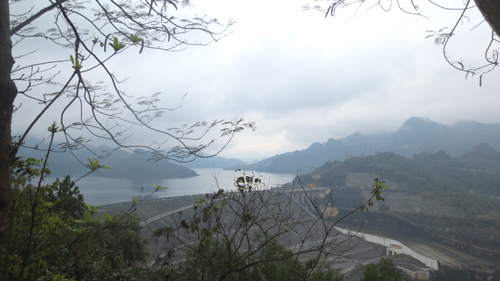
For decades, Thung Nai has become famous for its huge lake containing water powering the hydropower plant on Da River and the surrounding mountainous areas creating an ecosystem rich in flora and fauna.


The best time to visit Thung Nai is in the autumn and spring when the valley is filled with the romantic lake water and small islands are covered by green color of coconut trees. 


Travelling to Thung Nai, tourists can also visit Thac Bo cave - a national heritage - and discover the scenic beauty and distinctive culture of the Muong ethnic minority people.


Thac Bo is a deep cave separated by many levels. Behind the high and large entrance, visitors see multi-shaped stalactites mirrored on a limpid pond and listen to the stone musical instruments and gongs of the Muong ethnic group.


Many tourists in Thung Nai choose the Windmill guesthouse located on a small island as an ideal place for a comfortable and relaxing stay. The guesthouse area consists of a large two-storey redbrick house and a windmill offering visitors a breath-taking view of Thung Nai, and a stilt house functioning as a communal dinning place.


Staying in the Windmill, tourists will be served local specialties like grilled Muong pork, grilled Da River fish, hill chicken, and straw wine. After the dinner, tourists, especially the youngsters often gather for the campfire in front of the guesthouse, and watching the sparkling fishing canoe floating in the lake by night.


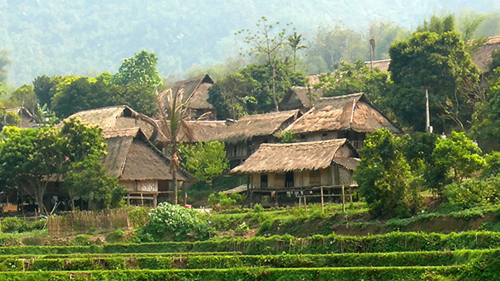
Thung Nai impresses anyone who sees it from the very first time with the harmonious combination of mountains, lakes and charming stilt houses nestled in between high hills.


Try to visit Thung Nai once in your life, tourists can enjoy the beauty of wild nature and witness the life of ethnic minority people living on the mountainous areas. Thung Nai promises to bring great tourism potential to Hoa Binh Province in the near future.


Source : dtinews[dot]vn

World’s largest rubber duck to entertain Vietnam 


A display of the world's largest rubber duck. PHOTO COURTESY OF VNEXPRESS


Ho Chi Minh City will become the 16th destination on the world tour of a 26-meter high rubber duck which is the world’s largest of its kind, online newspaper VnExpress reported.


The iconic duck, which weighs more than 600 kilograms, will be on display at the Ban Nguyet (Crescent) Lake in District 7 for one month starting on April 27.


The giant rubber duck was constructed with more than 200 pieces of PVC (polyvinyl chloride). There is an opening at the back of the body so that architecture/ staff can perform a body check of the rubber duck. 


In addition, there is an electric fan in its body so that it can be inflated at any time, in either good or bad weather. 


The creator of the giant rubber duck, Dutch artist Florentijn Hofman, tried to entertain the world by a tour named "Spreading joy around the world" established in 2007. He aimed to recall everyone's childhood memories by exhibiting the duck in 14 cities, starting in his own Amsterdam, Netherlands.


It has since been displayed in different cities around the world like Belgium’s Lommel, Japan’s Osaka,  Australia’s Sydney and Hong Kong


Hofman once said in an interview that he wanted to remind people around the world of their childhood’s memories with the world exhibition of his work.


Like us on Facebook and scroll down to share your comment


Thanh Nien News


Source : thanhniennews[dot]com

Vietnam’s first hiking train gets running


Source : news[dot]com[dot]vn

Which city is the most expensive in Vietnam?


152298


The most expensive city in Vietnam is not Hanoi, as far from thinking of many people. That distinction belongs to the central city of Hue.


The most expensive city in Vietnam is Hue.


Based on the CPI statistics provided by the General Statistical Office, we examined changes in the general prices in the five major cities of Vietnam: Hanoi, Ho Chi Minh City, Hai Phong, Hue and Da Nang, with 2004 as the base year.


Then, prices in the five largest cities were compared with the national average, with the changes normalized to the national average. Hence, if Hai Phong is listed as having a 2.5 percent change over the past decade, it means that prices in Hai Phong have grown 2.5 percent faster than the average for the country.  


Accordingly, Hanoi is the second cheapest and HCM City is the cheapest place in the five major cities. Prices in Saigon are more than six percent lower than the general level.


It is a big surprise to many that Hue is the most expensive city. Its prices are over 9 percent higher than the country’s average and nearly 16 percent higher than in Saigon.


Why do people think that Hanoi is the most expensive city? Probably it comes from the price of food here. Indeed, the prices of food and catering services in Hanoi have continuously increased more rapidly than the country’s average since the second half of 2008 and are now 13 percent higher than the national average. In contrast, the food price in Hue is the cheapest and it helps the city cover its "true face".


Why is HCM City the cheapest city in Vietnam? There are two main reasons. First, housing and construction material prices here have steadily declined since 2010, when the real estate bubble burst. Second, the prices of medical services in this city have not increased and are now nearly 30 percent lower than the nationwide average. As June 1, 2014, HCM City will adjust the prices for medical services, much later than the other four cities.


Source: VietNamNet


< Prev  


Source : news[dot]com[dot]vn

Saturday, April 26, 2014

Long holiday offers big break for tour companies


152214


A sharp increase in the number of people choosing different tour packages during the upcoming extended holiday next week has offered a golden opportunity to tourist companies to maximise turnover.


Shore thing: Nha Trang Beach in Khanh Hoa Province is packed with tourists. As the upcoming holiday falls in the beginning of summer, most tourists have opted for beaches or mountain resorts to escape the summer heat. — VNA/VNS Photo Quang Quyet


The five-day holiday for the Victory Day, April 30, and Labour Day, May 1, will start next Wednesday.


To celebrate the holiday, Fiditour, one of the country's largest tourist companies, has come up with special offers for its different tours. Therefore, it is offering discounts on tour prices ranging betweenVND500,000 and VND2 million.


In addition, the company has also introduced new tours to Ly Son Island in the Quang Ngai central province and Langkawi archipelago in Malaysia for this occasion.


According to director of the Fiditour's Marketing Department Tran Thi Bao Thu, until April 11, the number of clients purchasing tour packages of the company had increased 25 per cent in comparison with the same period last year.


The number of people purchasing tours abroad is slightly higher than the ones opting for domestic tours.


"While people choosing domestic tours tend to select tours to beaches and islands in the North and Central, the ones choosing tours abroad just pick destinations, such as Hong Kong, Malaysia, and Singapore for their holiday," Thu remarked.


Due to the soaring number of clients, the company had to stop taking any further bookings for their tours last week.


Similarly, Vietravel also witnessed a positive growth as the number of tourists travelling during this occasion increased 100 per cent in comparison with the same period last year, and Saigontourist welcomed about 15,000 clients, increasing 15 per cent.


Famous attractions, such as Da Lat, Nha Trang, and Phan Thiet still remain the top choices among the tourists.


To satisfy their "Gods", other big tourist companies, including Saigontourist, Peace Tour, OSC Viet Nam Travel, and Ben Thanh Tourist, have added more vehicles for transportation as well as offered some additional services.


"All the inter-tours to the Central and the North, and the tours to Nha Trang, Phu Quoc and Malaysia are fully booked. We have to deny all new bookings during this holiday," stated Ben Thanh Tourist's Director of Communication Nguyen Thi Tuyet Mai.


In Ha Noi, all tourist companies also have to try their best to meet the expectations of their clients.


According to Vietravel, they welcomed a large number of tourists, which has increased 300 per cent in comparison to the same time last year.


"Predicting the public's high demand to travel during this extended holiday period, Vietravel has made adequate preparations as we had negotiated with our partners, the service suppliers, to offer the best prices and quality services," emphasised Vietravel's deputy director Nguyen Le Huong.


Tour prices remain stable


Despite the soaring number of tourists, the tour prices are still stable.


Nguyen Cong Hoan, the deputy director of Hanoi Red Tours, reported that the tour prices this year are almost similar to the corresponding period last year, even slightly cheaper.


"Our company has presented a promotion programme for this occasion. Therefore, clients who register the tour with flights have received discounts ranging between VND500,000 and VND3 million, while the ones who joined the tours using vehicle transportation also received discounts between VND200,000 and VND300,000," he added.


Hoan also cited the reason for maintaining stable prices.


"Most of the tour companies have been seriously affected by the global economic crisis, causing under-expectation in the number of tourists. Hence, we have to jointly work towards boosting the market demand by keeping the prices stable," he stated.


Moving trend


As the holiday falls in the beginning of summer, most of the tourists have opted for beaches or mountain resorts to escape the summer heat.


It is not easy for tourists to directly book hotels and resorts in these locations as they are fully booked by tourist companies.


Thanh Trang, a woman living in HCM City's District 3, noted that her family wants to head to the beach during the holiday but she couldn't find any available accommodation.


"I have contacted all the hotels and resorts, from three-star to five-star, in Long Hai, Ho Tram, and Vung Tau [famous beach attractions], to check their availability, but they are all fully booked," she pointed out.


"It is the same situation in Nha Trang and Phu Quoc," she added.


For Ha Noi residents, tourist destination options seem to be more diversified. Many families are keen on taking two- to three-day tours to destinations surrounding the city, such as Ba Vi, Mai Chau, Moc Chau, Tam Dao, Dai Lai, and Thung Nai.


For the tours lasting three to five days, they select Dien Bien, Ha Long, and Da Nang. 


Source: VNS


Source : news[dot]com[dot]vn

Hoi An tightens ticket inspections


Authorities in this historic town are getting stricter about enforcing the mandatory entrance ticket policy, but their failure to explain the abrupt change has caused confusion among tourists, with many complaining about the fee on social media.


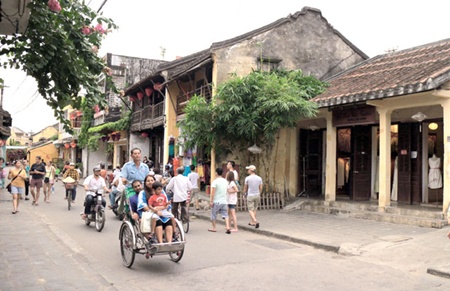
Foreign tourists walk though Hoi An Ancient Town. The Hoi An City authority has tightened inspection of fees for tourists visiting the town.


Foreigners pay VND120,000 (about US$6) and locals pay VND80,000 to visit the old town, which includes entrance to five major destinations.


The city added more ticket checkpoints early this month in order to limit the loss of revenue stemming from unauthorised ticket sales.


"The city started selling package tickets for tourists in 1995. It's common practice for world heritage sites. Tourists visiting destinations have to pay a fee, which goes towards conserving the heritage site and benefiting the local people," vice chairman of the city's People's Committee Truong Van Bay said. "We have not seen any protests from tourists or travel agencies about the fee. But the city's administration failed to explain it clearly and the poor manners of inspectors added to the confusion among tourists."


The vice chairman said the city hosted 1.6 million tourists last year, including 750,000 who stayed in the town. However, only 500,000 paid the entrance fee.


The city made VND76 billion (US$3.6 million) from tickets, only 80 per cent of the expected revenue. This was especially costly as Hoi An has to invest in night festivals in the old town seven days a week.


The vice chairman said some travel agencies intentionally did not include the ticket in the tour programme, so tourists had to pay for it on their own.


My Hanh, a tour operator of Da Nang-based travel agency Vitours, said her company always booked the entrance ticket for clients. However, she suggested that Hoi An administration explain the reason for the payment clearly to visitors.


"All tourists know that they have to buy tickets when visiting a world heritage site like Hoi An," Hanh said. "If tourists see a notice board saying that the ticket payment will go towards conserving the UNESCO-recognised world-heritage site, they won't mind paying a little money for their visit."


According to local visitor Ha My, ticket inspectors in Hoi An failed to send this message to tourists.


"They should gently explain the entrance fee to visitors, rather than just not letting them inside," My said.


"I also think the city should create more options for tourists. A tourist might want to wander around the old town, eat at a restaurant or buy some souvenirs, but not visit destinations like the Japanese bridge, Fujian and Jiao Zhou clubs and ancient houses and pagodas. In that case, they shouldn't have to pay VND120,000."


Pascal Daurel, a French tourist, said paying for such tickets was very common and he did not mind at all.


"It's necessary. Hoi An is a world heritage site and buying tickets is a way to contribute to conservation and restore the heritage," he said.


Vo Phung, director of the city's culture and sport centre, said that tourists might not understand the ticket policy because inspections in previous years were quite slack.


"Visitors thought that they could walk in the old town free of charge and just buy tickets if they visited the major destinations," he said. "Inspectors failed to explain the actual policy well, so visitors complained on Facebook and tourism websites."


The ticket crackdown has reduced the number of visitors to the old quarter in recent days, worrying households in the town.


"We saw more tourists in previous years, when walking around appeared to be free. I suggest that the city let tourists visit the old quarter free and just pay for visiting key destinations," said Minh Nhan, a resident in Hoi An.


Tomo Usuda, a Japanese tourist, said the strict inspections would hurt businesses like restaurants, souvenir shops and tailors.


"I think the city should offer cheaper tickets for tourists who don't want to visit sites," Usuda said. "It's so expensive to pay $6 just to walk around in the street and look at things."


Phung said residents of the old town and their friends would not have to buy tickets.


The city will host a press conference on ticket prices and inspections and other tourism-related problems on Saturday.


Hoi An was chosen for the 2013 Townscape Award by the UN-Habitat Regional Office in Asia.


Source : dtinews[dot]vn